
Finding Relief: Colic Treatment from a Top Chiropractor in Urbandale

Welcome to Levels Family Chiropractic. If you are reading this, you are likely exhausted, overwhelmed, and looking for answers. We understand that there is nothing more heart-wrenching than watching your newborn cry for hours on end, seemingly inconsolable.
As a premier Chiropractor in Urbandale, we specialize in helping families navigate the early challenges of parenthood by addressing the physical stressors that lead to colic. This guide will walk you through everything you need to know about colic, how to identify it, and how natural, gentle chiropractic care can help your baby (and your whole family) finally get some rest.
What is Colic in Kids?
Colic isn't a disease or a permanent diagnosis; it is a term used to describe a specific pattern of excessive, frequent crying in an otherwise healthy baby. While all babies cry, a colicky baby cries more than most.
Historically, doctors used the "Rule of Three" to define colic:
Crying for more than three hours a day.
Crying at least three days a week.
The pattern persists for at least three weeks.
Typically, colic starts around 2 to 3 weeks of age, peaks around 6 weeks, and usually tapers off by 3 to 4 months. However, for a parent in the thick of it, those few months can feel like a lifetime.
How Do You Know if a Child is Colic?
Identifying colic goes beyond just the duration of the crying. It’s about the nature of the distress. Common signs include:
Predictable Timing: Crying episodes often happen in the late afternoon or evening (the "witching hour").
Intense Crying: The crying sounds more like screaming or an expression of pain rather than hunger or a dirty diaper.
Physical Tension: You may notice your baby clenching their fists, arching their back, or pulling their legs up toward their tummy.
Inconsolability: Traditional soothing methods like rocking or feeding offer little to no relief.
Facial Changes: Their face may become flushed or bright red during a crying fit.
Root Cause of Colic
While conventional medicine often labels the cause of colic as "unknown," as a Chiropractor in Urbandale, we look deeper at the physiological stressors.
There are several contributing factors:
Digestive Immaturity: An underdeveloped digestive system may struggle with gas or the breakdown of proteins.
Overstimulation: A baby’s developing nervous system can become easily overwhelmed by sight and sounds.
The Gut-Brain Connection: If the nervous system is stuck in a "fight or flight" state, digestion slows down, leading to discomfort.
Birth Trauma: This is where chiropractic care is most vital. The process of birth (even "normal" births) involves significant pressure on a newborn’s delicate neck and spine. This can cause subluxations (misalignments) that irritate the nerves controlling the digestive tract.
What are the 5 S's of Colic?
Developed by Dr. Harvey Karp, the "5 S's" are designed to trigger a baby's "calming reflex" by mimicking the environment of the womb:
Swaddle: Snug wrapping limits startling movements.
Side or Stomach Position: Holding the baby on their side or stomach while awake and supervised can soothe them (always sleep on the back!).
Shush: Loud white noise mimics the sound of blood rushing through the placenta.
Swing: Rhythmic, jiggling motion helps reset the vestibular system.
Suck: Using a pacifier or finger can provide neurological comfort.
How to Relieve Colic Pain in Kids?
What are the Side Effects of Colic Calm?

Beyond the 5 S's, parents can try:
The "Football Hold": Lay your baby face down along your forearm with their head in your hand.
Warm Compresses: A warm (not hot) water bottle on the tummy can relax cramped muscles.
Tummy Massage: Gently rubbing the abdomen in a clockwise direction to help move gas.
Dietary Adjustments: If breastfeeding, the mother may try eliminating dairy or spicy foods. If formula-feeding, a switch to a hydrolyzed brand may help.
Many parents turn to "Colic Calm," a popular homeopathic gripe water. While it is generally considered safe, it does contain activated charcoal. Potential side effects include:
Temporary Darkening of Stool: This is harmless but can be startling for parents.
Constipation: In some cases, charcoal can slow down bowel movements.
Staining: Because it is black, it can easily stain clothes and blankets.
Drug Interactions: Activated charcoal is highly absorbent and can interfere with other medications if not spaced out properly.
Do Kids Grow Out of Colic?
The short answer is yes. Most cases of colic resolve on their own by the time the baby is 4 months old. This is usually because their digestive system has matured and they have gained better control over their nervous system. However, "growing out of it" doesn't mean the underlying tension has disappeared, it often just manifests differently as the child grows.
Does Colic Affect Babies Later in Life?
Research suggests that infants with severe colic may have a higher predisposition to certain conditions later in childhood, such as:
Abdominal pain or "tummy aches."
Childhood migraines.
Sleep disturbances.
Sensory processing sensitivities.
By addressing the nervous system early through a Pediatric Chiropractor in Urbandale, we aim to resolve these tensions before they evolve into long-term patterns.
Can a Chiropractor Help with Baby Colic?
Absolutely. This is one of the most common reasons parents visit Levels Chiropractic.
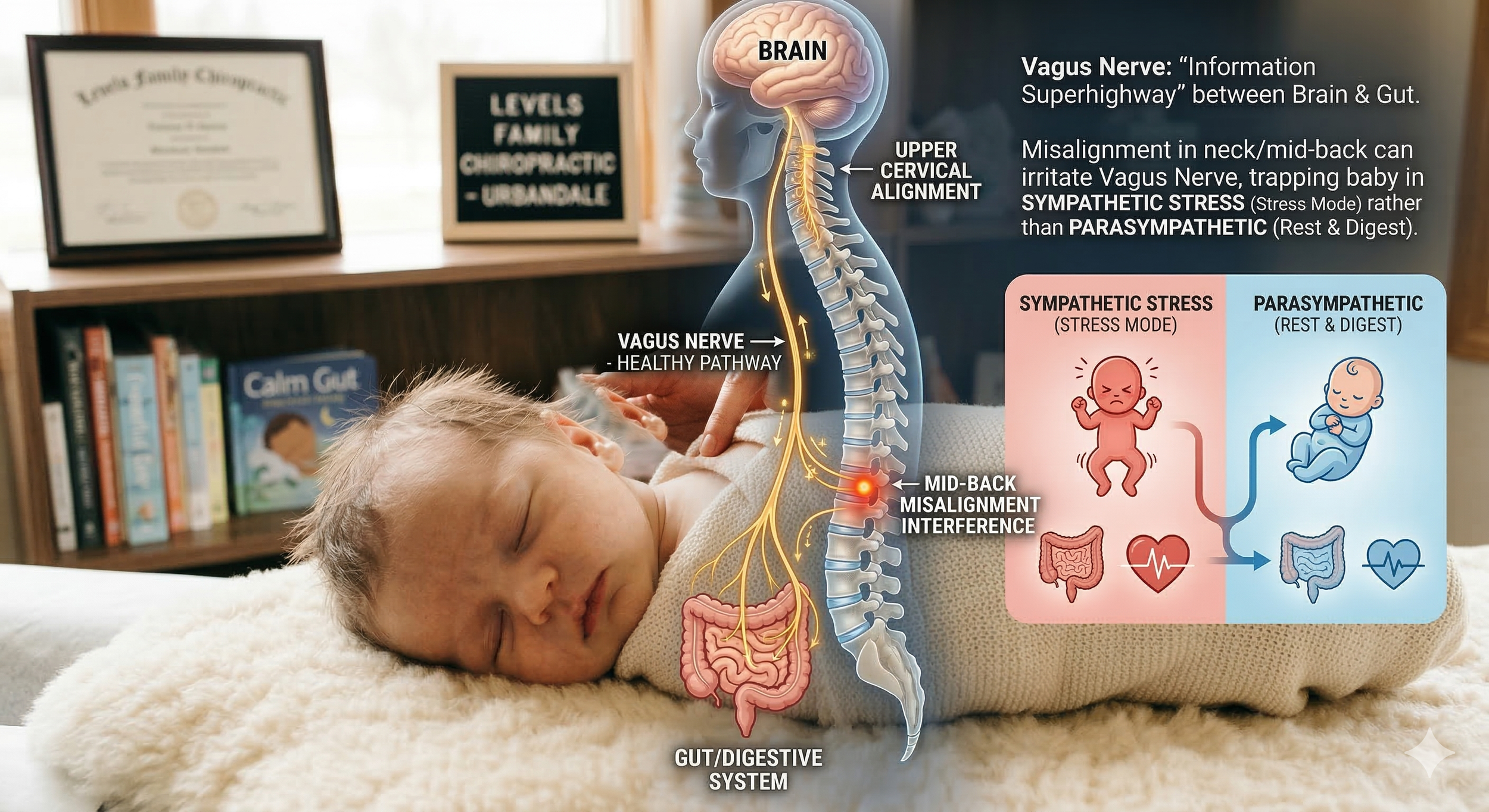
When a baby has a misalignment in their upper cervical spine (neck) or mid-back, it can interfere with the Vagus Nerve. This nerve is the "information superhighway" between the brain and the gut. If the Vagus Nerve is irritated, the baby’s body stays in a state of sympathetic stress (stress mode) rather than parasympathetic (rest and digest).
Clinical evidence supports this approach. You can read the systematic review on chiropractic care for colicky infants to see how manipulative therapy has been shown to reduce average crying time significantly.
What does pediatric adjustment look like?
It is nothing like an adult adjustment. We use no more pressure than you would use to check the ripeness of a tomato. It is a gentle, sustained touch that helps the baby's nervous system shift back into a state of ease.
What to Do When Your Kid Has Colic?
If you are at your wits' end, follow these steps:
Check for Safety: Ensure they aren't hungry, wet, or sick (fever).
Take a Break: If you feel your frustration rising, put the baby in a safe crib and walk out of the room for 5-10 minutes.
Seek Professional Evaluation: Don't just wait for them to "grow out of it." A pediatric chiropractor can determine if there is a physical reason for their distress.
Join a Support Group: Knowing you aren't alone is vital for your mental health.
Why Choose Levels Family Chiropractic for Colic treatment in Urbandale?
At Levels Family Chiropractic, we don't just treat symptoms; we look at the whole child. We understand the delicate nature of the infant spine and the immense stress colic puts on a household. Our goal is to help your baby reach their highest potential for health by ensuring their nervous system is functioning without interference.
If you are looking for a Chiropractor in Urbandale who specializes in pediatric care, we are here for you. We provide a calm, welcoming environment where your baby’s comfort is our top priority.