
Can Chiropractic Care treat Carpal Tunnel Syndrome
Chiropractic care may help relieve carpal tunnel syndrome by identifying and treating nerve compression along the entire median nerve pathway, rather than focusing only on the wrist. This article explains the symptoms and causes of carpal tunnel syndrome, what to expect during a chiropractic evaluation, and when treatment can provide symptom relief or long-term management.

What Carpal Tunnel Syndrome Really Is to Your Hand and Wrist
Most people think of carpal tunnel syndrome as a wrist injury. It is not. It is a nerve injury, and knowing that is key to finding relief.
Your wrist contains the carpal tunnel, a space formed by the carpal bones on the bottom and sides. The transverse carpal ligament creates a floor across the top of the space. Passing through this space is the median nerve and the tendons that move the thumb, index finger, middle finger, and half of the ring finger.
When the carpal tunnel shrinks because of inflammation or injury to its tendons and nerves, the nerve is compressed, and you have carpal tunnel syndrome. Here is why you need to pay close attention to how this injury manifests. Carpal tunnel nerve compression produces other symptoms in addition to pain.
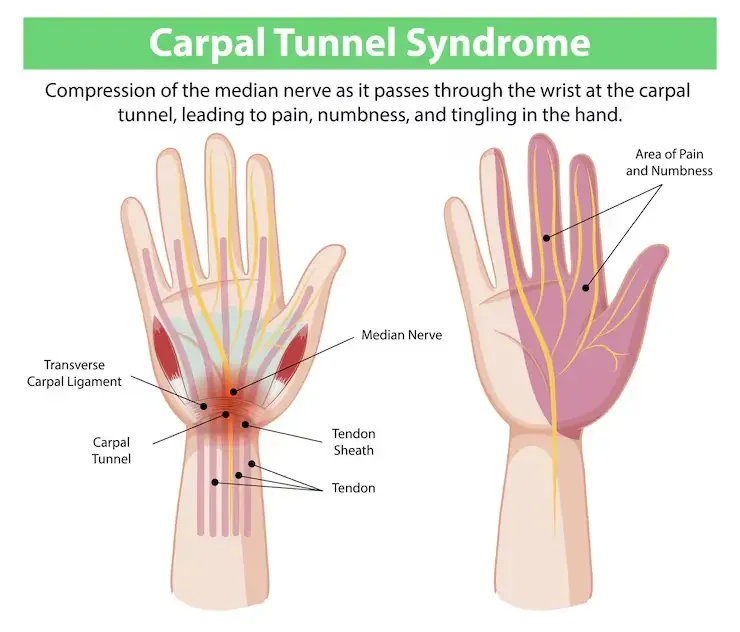
The pinky finger is not listed as a symptom of carpal tunnel syndrome because the median nerve does not serve that finger. The nerve ends before it gets there. If numbness or tingling is experienced in that finger, then the injury is likely not carpal tunnel syndrome. It is common that we have patients walk through the clinic doors with the conviction that they have carpal tunnel, only to have their symptoms suggest another condition.
Carpal Tunnel Syndrome Symptoms
Patients often are surprised when their carpal tunnel syndrome diagnosis comes out. The following list contains most of the common symptoms of carpal tunnel compression:
Numbness and tingling in the thumb, the index finger, and the middle finger
A burning or electric shock sensation that runs from the wrist through the palm to the elbow
Weakness in grip
Pain, aching, and numbness in the hand at night
A false sense of swelling, even if the hand is not swollen
Why the Symptoms Get Worse at Night

The nighttime aspect of carpal tunnel symptoms surprises many patients. Why should your wrist be bothering you more at night?
It has to do with wrist position. While we are not fully conscious of it, many people sleep in positions where their wrists are bent inward toward their elbows. This position further narrows the carpal tunnel, thereby increasing pressure on the median nerve.
Patients wake at night, unable to sleep because of this numbness, and must shake out their arms to regain sensation. The American Academy of Orthopedic Surgeons notes that nighttime symptoms are the most common early signs in patients with carpal tunnel syndrome.
Patients in Urbandale may experience these nighttime symptoms, especially if they spend hours typing and steering a wheel day after day.
Causes of the Pressure Inside Your Wrist

As previously stated, the tunnel's actual size does not shrink. The one variable is the amount of stuff crammed inside the tunnel. Swelling of tendons takes up extra space. Holding extra water does the same thing. Structural misalignment of the carpals within the bones may slant the tunnel in such a manner that less area is accessible for the nerve.
But what's less known is that the median nerve doesn't only begin inside the wrist. It extends throughout the length of your forearm, all the way to the elbow and past your arm, through your shoulder, then links to the cervical nerve origins (the neck).
Compression along any part of that line may lead to symptoms like those associated with Carpal Tunnel Syndrome. The inquiry as to whether a chiropractor will be able to remove carpal tunnel syndrome is more intriguing than you might imagine. Your answer may depend on what the cause is.
The first step in finding the underlying cause of your symptoms is understanding anatomy. That is what separates a solution from a placebo effect.
Carpal Tunnel Chiropractic Care Looks Beyond the Wrist

The second thing a lot of people don't realize until they walk into a chiropractor's office is that carpal tunnel syndrome doesn't always begin in the wrist.
The median nerve originates at the base of your neck, runs through your shoulder, down your arm, and extends to your hand. Compression along any part of this line may cause similar symptoms in your fingertips, such as tingling, numbness, and weakness.
This is why Chiropractors take the whole picture. Not just the place where the pain is.
Patients will come in believing the cause is within the wrist, and upon assessment, we may discover it is actually a cervical spine misalignment that is irritating the nerve root. Addressing the wrist only is an educated guess. Looking at the entire nerve pathway helps find the issue.
What a Chiropractor Will Assess

The Chiropractor Assessment for Carpal Tunnel syndrome is more than just looking at the wrist. It involves examining all the structures the median nerve passes through. Below is what is normally assessed.
Cervical spine to assess if the vertebrae are out of alignment, causing nerve impingement (pinched nerve) in the neck
Cervical spine to assess if the vertebrae are out of alignment, causing nerve impingement (pinched nerve) in the neck
Elbow and forearm to check for tightness and tightness in muscles that may be compressing the nerve in the forearm
Wrist and Carpal Tunnel for mobility of the joints and for soft tissue tension within the carpal tunnel
Posture to determine how your posture is loading up the nerve
The last point I want to discuss is the posture. Many people in Urbandale spend a long period of time sitting in an office setting, in addition to commuting. A person who sits with rounded shoulders and a head-forward position is placing a lot of stress and strain along the entire nerve pathway. By the time you notice symptoms in the hand, the issue has likely been brewing for some time.
The Importance of The Neck and Shoulder
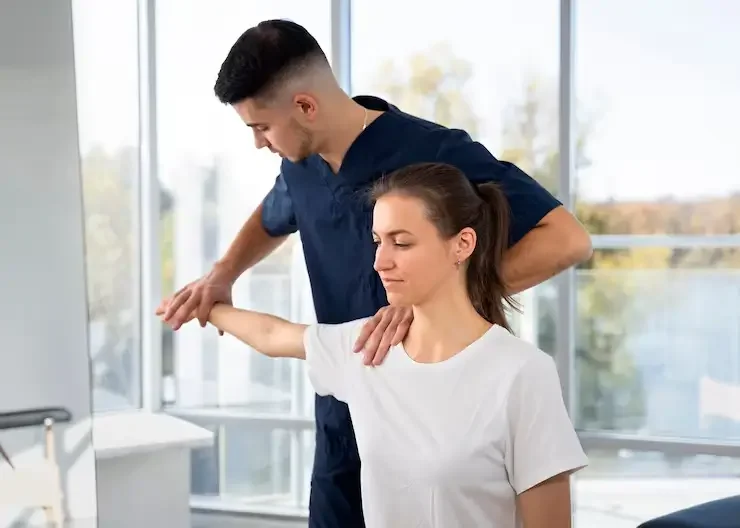
Consider the hose. If someone steps on it anywhere along its length, the flow at the end of the hose slows.
Similarly, the median nerve may be compressed or pinched in the neck or shoulder, resulting in numbness, reduced grip strength, and other symptoms in the hand, even though the wrist itself may not be the cause.
The "Double Crush" Phenomenon

This is known as the "double crush" phenomenon, a problem more prevalent than many individuals suspect. Research published in the Journal of Manipulative and Physiological Therapeutics suggests that those with nerve compression at multiple sites along a single nerve pathway may benefit from a treatment plan that reduces compression at each site.
In these cases, chiropractic care for the neck can help relieve the stress the nerve is experiencing in the cervical region. When the neck moves more freely, the entire nerve pathway may also have more room to operate.
This is also the time when soft-tissue work on the forearm and shoulder, stretches for the thoracic outlet, and postural correction all come into play.
Postural assessment and correction are another key element. While a joint can be adjusted, bad habits are not usually eliminated that quickly. I always emphasize to patients that we don't just treat the site of the pain, but the situation that gives rise to it. This approach sets chiropractic care for carpal tunnel apart from splinting a wrist and hoping for the best. This is the difference between getting actual long-term relief and merely being quiet for the moment.
Eliminating vs. Managing Carpal Tunnel: What Chiropractic Care Can Do
This is a question I get more often than any other: Can chiropractic care eliminate carpal tunnel syndrome? My response is always: Well, that depends on the factors that cause the symptoms, which many people don't understand at the outset. Here is the important point: carpal tunnel syndrome is caused by compression of the median nerve. This nerve runs from the neck down through the shoulder and arm, into the wrist.
People often assume that the problem is just in the wrist, but a nerve can be compressed at several places between the neck and the wrist. So, if patients report that chiropractic care "didn't work" for their carpal tunnel syndrome, you must first ask whether the wrist was the site of the problem to begin with.
What Does the Treatment Do?
Chiropractic adjustment works on the spine and joints. The cervical spine in the neck, when misaligned, can compress the nerves that extend out to the hand and wrist. I have witnessed this many times with patients in my office.
A patient walks in saying they think they've hurt or broken their wrist, and what we uncover is often tension and restriction in the mid-neck and upper thoracic spine. Aligning these regions relieves the pressure on the nerve. Some patients get almost from that adjustment.
Others still need to see us for treatment focused on the wrist joint, as well. It can be either, or both. We also check the elbow, the shoulder, and the thoracic outlet, a space in your upper body that sits between your collarbone and your first rib, and is also a common area where the nerve may be getting pinched. Nearly every patient who comes in with hand or arm pain is also assessed and treated for poor posture, as it is often a contributing factor


Realistic Outcomes: Elimination Vs. Long-Term Management
Straight up, sometimes after a course of care, our patients get 100% relief from their symptoms. This is especially true when the nerve compression comes from a more spinal source and less from serious structural damage to the wrist joint. Patients with carpal tunnel syndrome who receive chiropractic treatment have shown improvements in grip strength, pain, and nerve conduction measurements, according to a study published in the Journal of Manipulative and Physiological Therapeutics. However, not everyone walks away with complete relief.
Some patients have suffered from CTS for years. The longer you've had the pain, the more scar tissue may have formed around the injured nerve. This nerve has now become accustomed to being compressed.
Chiropractic care becomes a management modality, rather than a corrective one, and management is a victory. Reduced symptoms, improved function, fewer flare-ups. This isn't a loss, it's a win.
The outcome of your treatment, toward complete resolution or management, is based on a few different variables:
How long have you been experiencing symptoms? Earlier treatment typically resolves more rapidly.
Is the compression coming from the spine, the wrist joint, or somewhere in between?
Your habits: how do you sit when typing? What's your posture? How often do you perform repetitive motions? How do you position your wrist at night?
Inflammation in the nerve itself?
I work with an office worker in Urbandale, for instance, who sits at his desk all day, drives on 35 after work, then goes home and spends several hours scrolling on his phone on the couch. That's his entire day of bad posture and poor wrist positioning. In this scenario, chiropractic care will help him manage his pain, and he'll need to adjust his daily habits so that the nerve remains healthy going forward.
It is true that many of our patients do make lifestyle adjustments to complement their care. It's often overlooked how chiropractic treatment can facilitate the body's healing process, but if patients go right back to doing the activities that caused the compression in the first place, they'll still deal with pain. Adjustment and lifestyle changes are the two essential tools in our toolbox. If you are not sure where your symptoms originate, an assessment can help you identify the source. Our back pain treatment and neck pain treatment centers are great ways to begin understanding your symptoms before drawing conclusions about your wrist.
Frequently Asked Questions
Can chiropractic care actually eliminate carpal tunnel syndrome, or just manage the symptoms?
Chiropractic care can eliminate symptoms in some cases, but it depends on the cause. If your symptoms come from a misalignment in your neck, shoulder, or wrist, adjustments may fully resolve the problem. If the nerve is severely damaged, chiropractic care may reduce symptoms without fully eliminating them. The key is finding where the compression actually starts. That is why a full nerve pathway assessment matters more than treating the wrist alone.
Why do carpal tunnel symptoms feel worse at night for Urbandale residents who work desk jobs?
Nighttime symptoms get worse because of wrist position during sleep. Many people bend their wrists inward without realizing it. This narrows the carpal tunnel, increasing pressure on the median nerve. For people in Urbandale who spend hours typing or driving each day, their nerves are already stressed before bedtime. Adding a bent wrist position while sleeping pushes symptoms over the edge. Shaking out your hand to restore feeling is a common sign that this is happening.
Is it a mistake to only treat the wrist when you have carpal tunnel symptoms?
Yes, treating only the wrist is a common mistake. The median nerve starts in your neck and runs through your shoulder, elbow, and forearm before reaching your hand. Compression anywhere along that path can cause the same tingling and numbness you feel in your fingers. If the real problem is in your cervical spine and you only treat the wrist, you are missing the source. Symptoms may return or never fully go away.
How do I know if my hand numbness is carpal tunnel or something else?
True carpal tunnel syndrome affects the thumb, index finger, middle finger, and half of the ring finger. If your pinky finger is also numb or tingling, the median nerve is not the cause. That finger is served by a different nerve entirely. Other conditions, like thoracic outlet syndrome or a pinched nerve in the neck, can mimic carpal tunnel exactly. Getting a proper assessment is the only way to know for sure.
What does a chiropractor actually check during a carpal tunnel assessment?
A chiropractor checks the entire path the median nerve travels, not just your wrist. That includes your neck, shoulders, collarbone area, elbows, forearms, and wrists. Your posture is also evaluated. Many Urbandale patients who sit at a desk with rounded shoulders and a forward head posture are loading the nerve from multiple points simultaneously. Our chiropractic care walks through how this full-pathway approach leads to better outcomes than wrist-only treatment.
Can bad posture from office work in Urbandale actually cause carpal tunnel symptoms?
Yes, posture plays a bigger role than most people expect. Sitting with rounded shoulders and your head pushed forward puts strain on the entire nerve pathway. By the time you feel numbness in your hand, the problem has often been building for months. Many people in Urbandale spend long hours at a desk and in a car each day. That combination creates the exact conditions that allow nerve compression to develop slowly over time.